03 · Hunt
Threat Hunting
Run hypothesis-driven hunts across SIEMs, cluster the hits, verdict the result and promote what works.
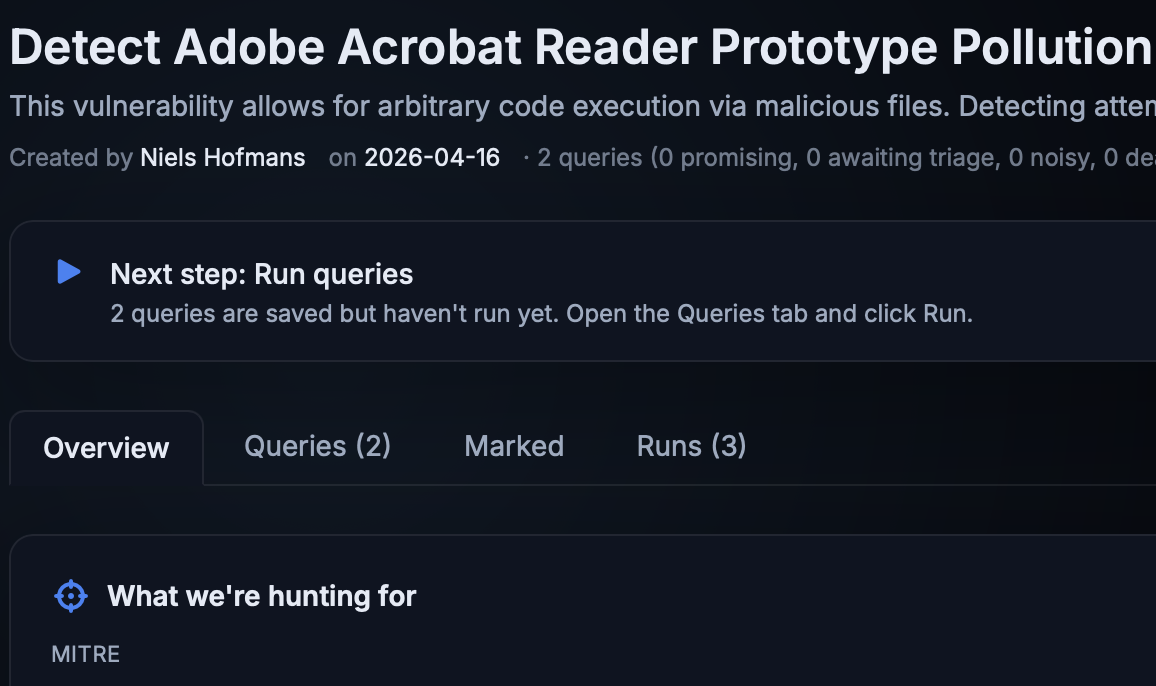
- 01 Create hunts from risks, threat briefs, ethical hack findings, or analyst prompts.
- 02 Run one hypothesis across multiple SIEMs and preserve per-platform result state.
- 03 Verdict clusters, keep notes and promote winning queries to tested rules.
Outcomes
What this changes for the team.
Speed
Hunts become routine
Analysts work clustered evidence instead of manually paging through raw SIEM rows.
Consistency
Verdicts are recorded
True positive, false positive and inconclusive decisions stay attached to the hunt.
Handoff
Good hunts become rules
A useful query can be promoted into a governed detection workflow with tests and review.
The problem
SOC teams often know what they should look for but cannot afford the manual effort. A hunt starts as a hypothesis, becomes a set of SIEM queries, returns too many rows and then depends on whichever analyst has time to interpret the result. The final answer is rarely captured in a way that improves the detection program.
That means the same investigation is repeated later and a good query does not always become a production rule. The organization stays busy but does not necessarily become more covered.
How CraftedSignal structures hunts
A hunt is a bounded investigation against one or more connected SIEMs. It can start from a threat brief, a modeled risk, an ethical hack finding, or an analyst prompt. CraftedSignal compiles the query for the target platforms, tracks each SIEM result separately and records retries or failures without losing the overall hunt state.
Results are clustered so analysts can verdict patterns instead of individual rows. A cluster might represent repeated behavior from the same host, user, process lineage, domain, or detection pattern. Notes stay attached to the cluster and the hunt timeline.
Verdicts that matter later
Each cluster can be marked true positive, false positive, or inconclusive. That decision is not just a comment. It becomes evidence for whether the hypothesis was real, whether a rule should exist and whether the risk it came from is still open.
When a query produces useful signal, CraftedSignal can promote it into a detection rule. The workflow then moves into authoring, testing, approval, deployment and monitoring. A hunt is no longer a dead-end investigation; it is one way the detection library grows.
Runbooks and playbooks attached to the hunt can move into the promoted rule, so the analyst handoff stays with the detection work that came out of the hunt.
Where hunts fit in the loop
Hunts are the bridge between “we might be exposed” and “we have proven coverage.” They are useful before writing a rule, after an ethical hack, when a new threat brief lands, or when a rule has gone silent and the team needs to know whether the behavior still exists.
For managers, the value is repeatability. The hunt has a source, owner, verdicts, related risks and a promotion path. For analysts, the value is less raw-row work and fewer manual handoffs.
Related docs
Go deeper in the technical docs.
Threat Hunting
Hunt lifecycle, clustering, verdicts, promotion and multi-SIEM behavior.
Testing
How promoted rules get positive and negative tests against live SIEMs.
Simulations
Run technique-shaped activity and correlate whether detections fire.
Runbooks & Playbooks
Response steps that move from hunts into promoted rules.
Rules
Rule structure, metadata, lifecycle states, tests and ATT&CK mappings.
Next feature sets